Sample Reports
Our reports are the reason clients choose SkyView. See the depth, clarity and precision of a typical SkyView roof survey report.
Every report, built like engineering documentation
Each SkyView report follows a consistent, rigorous structure designed to give you total clarity on the condition of your roof — supported by high-resolution drone imagery throughout.

Nine sections, one complete picture
Executive Summary
A concise overview of the roof condition, key findings and headline recommendations — the first page decision-makers read.
Roof Overview
Description of the roof type, materials, construction and overall condition assessment.
Drone Images
High-resolution 4K aerial photographs capturing every elevation, valley and ridge of the roof.
Annotated Photographs
Each defect pinpointed on imagery with coordinate markers and severity classification.
Defects
Detailed description of every identified defect, its location and likely cause.
Priority Ratings
Each defect classified by urgency — from immediate attention to monitor only.
Recommendations
Clear, prioritised guidance on remedial works, written in plain English.
Estimated Remaining Lifespan
Professional assessment of the remaining service life for the roof and its components.
Maintenance Advice
Practical guidance to extend the life of your roof and prevent future defects.
A real report, three real defects
Below is an extract from a typical SkyView report — broken tiles, failing chimney flashing and a flat roof with tears — exactly as a customer receives it, with location, cause, risk and a plain-English recommendation for each.
Report ref
SVRS-2026-0418
Property
Sample property, East Anglia
Survey date
14 March 2026
Surveyor
SkyView Roof Surveys
Executive summary
The roof was inspected by drone and three defects were identified. Two are high priority — broken tiles on the front pitch and failing flashing at the chimney — both of which present an immediate risk of water ingress and should be addressed promptly. The flat roof membrane has tears and is medium priority; it needs interim patching now and replacement within 12–18 months. None of the defects are unusual for a roof of this age, and all are repairable at modest cost if dealt with before further weather damage occurs.

 D-01
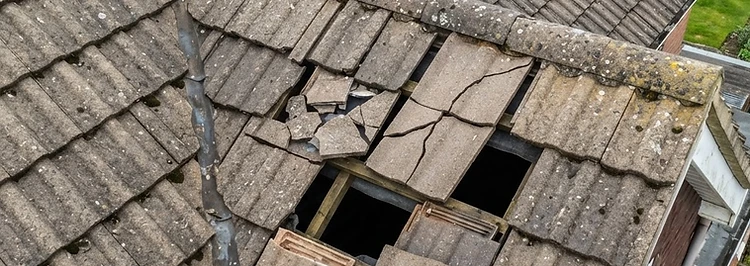
D-01Broken and slipped roof tiles
High priorityThree concrete interlocking tiles are cracked and a further two have slipped from their nibs, leaving the underlying membrane exposed. The damage is consistent with impact or age-related nib failure.
- Likely cause
- Likely a combination of tile fatigue and wind uplift; slipped tiles suggest the nibs have become brittle.
- Risk if left
- Open gaps allow water to track beneath neighbouring tiles and into the batten void, with a real risk of ingress to the ceiling below during driving rain.
- Recommendation
- Replace the broken and slipped tiles and check the surrounding rows for nib deterioration. Cost is modest if caught now — left, the roof membrane and internal ceiling are at risk.

 D-02
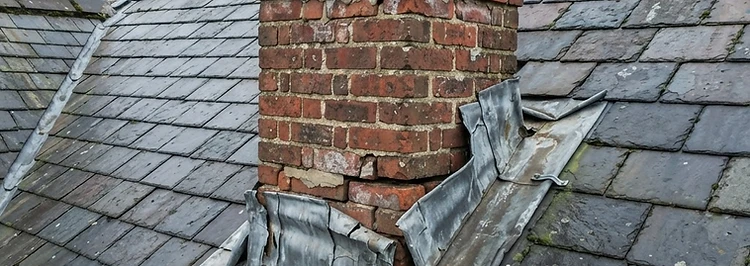
D-02Failing chimney flashing
High priorityThe lead step flashing around the base of the chimney is cracked and lifting away from the brickwork, with visible gaps at the joints. The apron flashing has separated from the mortar joint.
- Likely cause
- Age-related lead fatigue and thermal cycling; the pointing into the brickwork has also deteriorated.
- Risk if left
- This is a classic water-ingress point. Rain running down the stack will enter behind the flashing and track into the roof space, often appearing as damp patches on the chimney breast internally.
- Recommendation
- Re-form the lead flashing and re-point the chimney stack. A relatively small, targeted repair now avoids the cost of internal redecoration and possible timber decay later.

 D-03
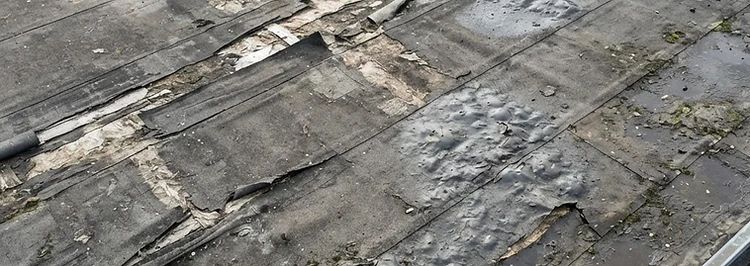
D-03Tears in flat roof membrane
Medium priorityThe mineral-surfaced felt membrane shows several tears and splits, with localised bubbling where the felt has delaminated from the substrate. One split runs along a joint for approximately 400mm.
- Likely cause
- UV degradation and thermal movement over time; the membrane has lost flexibility and is splitting at stress points.
- Risk if left
- Tears will widen with each freeze-thaw cycle. Water is already ponding in the delaminated areas; left, this will penetrate the deck below.
- Recommendation
- Patch the active tears as an interim measure, and plan to overlay or replace the membrane within the next 12–18 months before the deck is compromised.
Estimated lifespan
Main pitched roof: 15–20 years with the repairs above. Flat roof: 12–18 months before replacement is required.
Maintenance advice
Clear gutters each autumn, re-point the chimney within 12 months, and re-inspect the flat roof after any heavy snowfall.
Want a report like this on your roof?
Book a surveySee your roof with total clarity
Book a SkyView survey and receive a report built to the same rigorous standard.
Book a Survey